Showing posts with label sci-fi. Show all posts

Tuesday, June 6, 2017

Read This! - Symmetry (Vol. 1)


In today's age of technology, we all like to be connected to our devices, whether it's at work, at home, or even in our cars.  But what if this connectivity was something we had from birth?  This is the starting point of Symmetry, written by Matt Hawkins and illustrated by Raffaele Ienco.
Symmetry tells a story very similar to Brave New World, in which the world's population is kept heavily medicated and connected to their AI system at all times.  The people are also a homogenous society, even to the point that all races are kept completely separate.  When disaster strikes and disconnects a small segment of people from their AI system, a man named Michael discovers Maricela, the first black woman he's ever seen.  The two fall in love while working together to survive the new terrors of life without AI assistance.  Meanwhile, the administrators of this 'utopia' race to rebuild their society under the guidance of a mysterious AI whose ultimate aims are unknown.
Co-creator Raffaele Ienco illustrates this book with clean lines and sharp colours, but the main attraction here is the storytelling of Matt Hawkins.  While it starts out simple enough, there are a lot of complex ideas under the surface here.  Symmetry deals with ideas of segregation, morality, and our relationship with technology.  While I personally was hoping for something a little more complex, it appears that Symmetry's story does unfold further in following chapters.  Hawkins and Ienco have mixed elements from sources like Brave New World, The Matrix, and the long-term thinking of Frank Herbert's Dune novels to deliver an interesting take on the sci-fi dystopia genre.  Go check it out for yourself today at The Gauntlet Comics and Games!

Monday, May 29, 2017

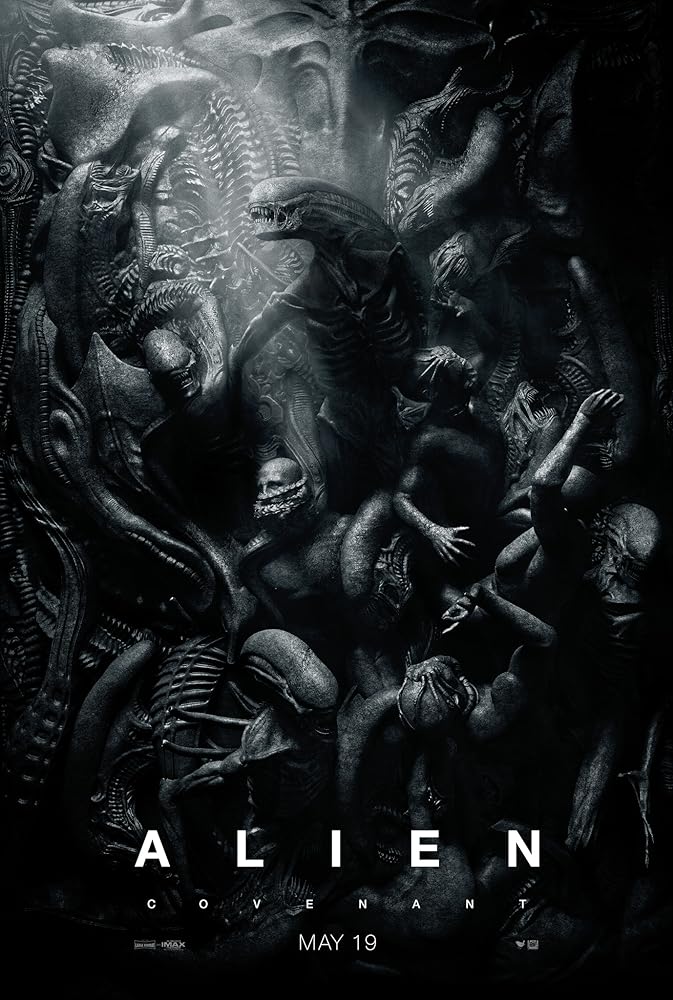
Alien: Covenant (2017)


Alien: Covenant, the follow-up to Prometheus (2012) begins with a disaster on board the colony ship Covenant, bound for a new and distant planet.  Many of the colonists and crew are killed, but there is a glimmer of hope in the discovery of a much closer Earth-like planet.  The crew decide to examine the planet closer, and make some startling discoveries.  After some horrifically disastrous contact with a dangerous alien spore, the Covenant's crew are taken in by the android David (Michael Fassbender), last survivor of the Prometheus.  The crew discovers that in his time on the planet, David has become something of a Dr. Moreau type, experimenting with the title creatures and refining them into the fearsome killing machines we see in later films.  After this point, the movie follows some familiar patterns, as the crew on the planet fight to survive while the others still aboard the Covenant desperately try to make contact with them.
As befits Ridley Scott's return to the Alien franchise, Alien: Covenant contains a good helping of thrills and tension, as well as a few gruesome shock scenes.  While the crew of the Covenant don't have the deepest characters in cinema, there is enough detail to make them distinctive and memorable.  In particular, I enjoyed watching Daniels (Katherine Waterston), who seems built for a crisis situation, and shares many personality traits with the more famous Ellen Ripley.  Also notable is acting-captain Tennessee (Danny McBride), who goes through a range of emotions over the course of the movie.  Finally, Michael Fassbender gives a very impressive performance, playing both David and the Covenant's android crew member Walter.  Although the two characters are essentially the same, Fassbender plays them with enough variation that they appear different in subtle ways.
The visual effects are about what's to be expected for an Alien film, although it does seem to lean a little more on the side of CGI effects over the physical element.  That being said, it makes the scary moments no less scary for it.  This atmosphere is helped along by the moody, synthetic sounding score of Jed Kurzel.
There are some philosophical and religious undertones to Covenant, but they seem to serve as a framework that the film is built on rather than communicating any sort of deeper message. (apart from the obvious 'don't play God' themes)  This is a welcome relief and contrast from the uproar Prometheus caused in some political/religious groups back in 2012.
If you were to ask me if Alien: Covenant is a good movie, I'd say yes.  However, if you were to ask me if it's better than Alien, I would question the reasoning of your comparison.  The fact is, there is never going to be another movie that matches the tone and style that Alien created, as much as some fans might want that.  Alien: Covenant is a good piece of sci-fi horror, and an interesting addition to the Alien canon.  Of course, if you'd rather just see Alien again, I suggest you stay home and let other people enjoy the movie.

Monday, May 15, 2017

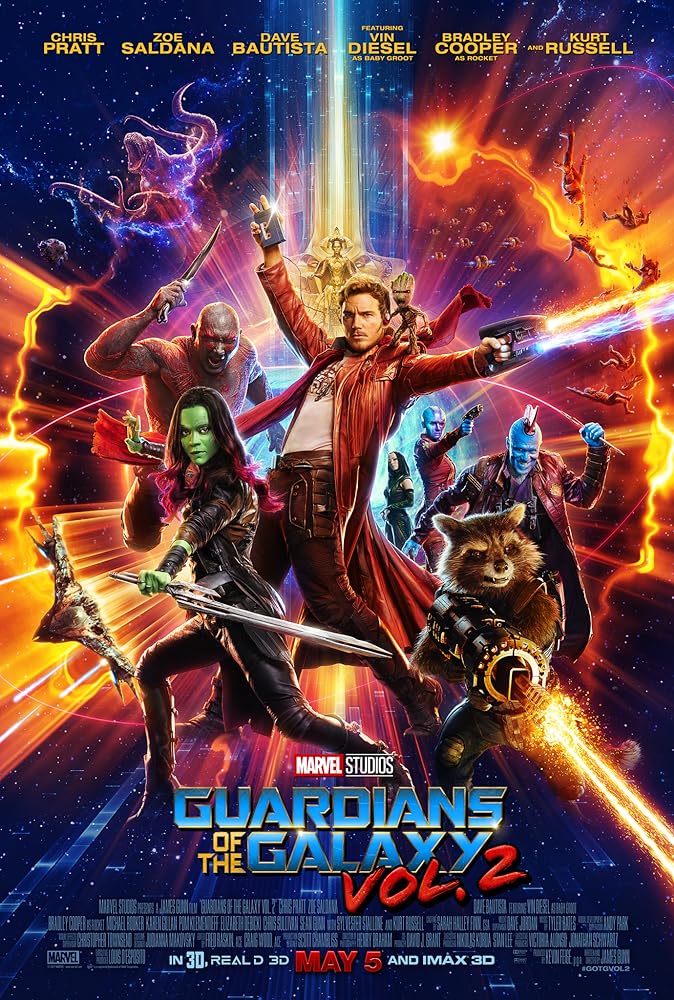
Guardians of the Galaxy Vol. 2 (2017)


The movie that got us all 'hooked on a feeling' in 2014 is back!  This time around Peter 'Star Lord' Quill (Chris Pratt) and friends find themselves on the run from a golden-skinned race known as the Sovereigns after they discover a small theft by Rocket (Bradley Cooper).  During the chase, they are rescued by a mysterious man known as Ego (Kurt Russell) who reveals himself to be Peter's father.  The Guardians are invited to his home planet, where we discover his surprising motivations for searching out his son.  Meanwhile, Yondu (Michael Rooker) and his space-pirate crew the Ravagers have fallen on hard times, resulting in an internal power struggle.  Eventually Yondu's crew catches up with the Guardians, but by this time, their situation has changed dramatically.  Banding together for the greater good, the Guardians, along with Yondu and Nebula (Karen Gillan) face off against an unexpected villain in a fight that will determine the safety of the entire galaxy!
As is expected with any Marvel film, Guardians Vol 2 is full of eye candy, from the excellent makeup to the outstanding visual effects.  Thankfully, the quality of writing is just as good as the effects.  Every character gets a good amount of screen time.  Peter and Gamora (Zoe Saldana) continue their indecisive attempts at romance, Rocket and baby Groot (Vin Diesel) get numerous chances to explode people, and Drax (Dave Bautista) begins to understand the nature of love, as well as having some of the funniest moments in the movie.  I also appreciate that this sequel put a spotlight on the 'villains' from the first instalment, giving them some very complex new depth of character.
It would be irresponsible of me to talk about a Guardians film without discussing the soundtrack.  Once again, the music is made up of various hits and one-hit-wonders of the disco era, but something about this soundtrack doesn't feel quite the same.  It still has some very well chosen songs for the big moments, but overall, it doesn't seem nearly as vibrant or memorable as the first movie.  After some reflection, I think this has something to do with the context of the first film.  Guardians of the Galaxy started from a deep emotional place, which imprints itself on an audience very strongly.  As well, the first film was our introduction to these characters we now love, so those musical moments become even more ingrained in our unconscious, much in the same way we associate John Williams's Imperial March with Darth Vader, for instance.
As is the case with any Marvel movie, there is a small collection of post-credit sequences.  A few of them are chuckle-worthy, but unless you're well-versed in Marvel comics lore, there's not much worth sticking around for.
Guardians of the Galaxy Vol. 2 is full of action, laughs and adventure.  But more than this, it has a serious emotional story to tell.  Ultimately, it's a story about family.  We don't get to choose our relatives, but we do get to choose who we call our family.  Guardians explains this to us in a very clear and poetic way, and is a big reason I think it improves on the original.  If you're a fan of the original, or just like Marvel movies in general, I highly recommend you see this while it's still in theatres!

Monday, May 8, 2017

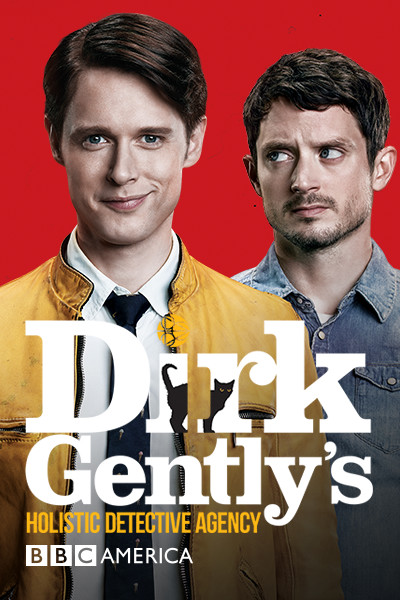
The First Three - Dirk Gently's Holistic Detective Agency (2016)


Produced by Netflix and BBC America, Dirk Gently's Holistic Detective Agency chronicles the strange investigations of the title character (Samuel Barnett), and his unwilling assistant Todd (Elijah Wood).  The disarmingly friendly Dirk Gently differs from most detectives in that he uses a 'holistic' method of investigations.  In practice, this means that he doesn't interview witnesses or look for clues.  He simply goes about his business until he inevitably stumbles onto whatever clue unlocks the entire mystery.  He meets Todd under some very bizarre circumstances, and decides Todd will be his new assistant; the Watson to his Holmes, as it were.  Todd wants nothing to do with Dirk initially, but circumstances keep causing the two to cross paths, so Todd eventually resigns to his sidekick role.  At the same time, another pair of real detectives, Zimmerfield and Estevez (Richard Schiff and Neil Brown Jr.) are trailing Dirk and Todd, since the pair seem to be connected to some very bizarre cold cases.   Meanwhile, across the country, electrician/part time hacker Ken (Mpho Koaho) is abducted by 'holistic' killer Bart Curlish (Fiona Dourif).  Her life's mission is to kill Dirk Gently, even though the two have never crossed paths.  Dirk and Todd spend their time solving bizarre mysteries and avoiding death/capture, while the rest follow the trail they've left, in an exciting and strangely funny series.
For a series this unusual, the writing has to be spot on to keep the tone consistent, and it doesn't disappoint.  The writers have a clear appreciation for the original Douglas Adams novels.  The dialogue and plotting has all the earmarks of Adams's work, from silly arguments over semantics to odd speech patterns and out-of-the-blue weirdness.  The mysteries themselves are densely layered, but manage to have surprisingly coherent solutions in spite of their outlandish nature.  The production design goes a long way to helping the audience accept the strangeness of Dirk Gently's world.  Everything feels just a bit off-centre from regular life, and eventually, we're drawn into the strangeness and we begin to think like Dirk Gently would.  For instance, the idea of a shark attack on dry land becomes more of a brain teaser than a flat-out impossibility.
The pure strangeness of this show is brought to life by Samuel Barnett's portrayal of Dirk Gently.  While the show is set in America, Dirk is English through and through, which is a nice nod to the original books.  As mentioned above, Dirk is almost always cheerful and friendly to everyone, even in the middle of a grisly crime scene.  It's amusing to see other characters trying to decide how to respond to his friendliness.  Elijah Wood's character is very similar to the one he played in Wilfred: Todd is constantly frustrated with Dirk's actions, yet consistently winds up advancing the action whatever decision he makes.  The rest of the cast are excellent as well and provide good contrast with the main players.  Detectives Zimmerfield and Estevez don't have as much screen time, but they share some of the most amusing moments in the series with their hard-boiled dialogue and deadpan reactions to all the weirdness around them.  For me, the standout performances belong to Mpho Koaho and Fiona Dourif as Ken and Bart.  Ken seems to be a nice guy who was in the wrong place at the wrong time.  His fear of Bart feels very real, and it's very interesting to watch that fear fade away as the two become uneasy friends, of a sort.  Despite first appearances, Bart is a fascinatingly complex character.  Fiona Dourif manages to make Bart scary, yet shows a certain sensitive side at times.  Even though Bart is ostensibly the villain of this story, she becomes likeable in the strangest way.
If you like a good mystery, but are tired of the same old predictable stories, Dirk Gently's Holistic Detective Agency is the right show for you.  Dirk Gently combines sci-fi elements with solid mystery structure and comedic punctuation to create a very entertaining show that defies expectations.  If you haven't seen it yet, it's worth a look!

Tuesday, March 14, 2017

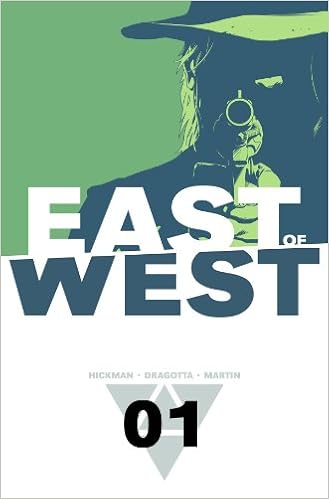
Read This! - East of West (Vol. 1)


Read This! is made possible by The Gauntlet Comics and Games

At first glance, sci-fi and western don't seem to be genres that would mix well.  However, the popularity of shows like Westworld proves that it can be done with the right concept.  East of West (published by Image Comics) is another of those unusual genre mixes that works surprisingly well, and is a refreshing departure from typical comics.
Written by Jonathan Hickman (best known for his work with Marvel, including the recent Secret Wars miniseries), East of West takes place in an alternate universe where the American Civil War never truly ended, along with Mao Zedong's China.  The story also deals with the possibly impending apocalypse.  That is, if the Four Horsemen can locate Death, who has gone off the reservation, so to speak.  With the help of a mysterious native couple, Death wanders the land in search of his former lover, Xiaoling.  The only issue is that Xiaoling is the daughter of Mao III, current leader of the heavily fortified city-state New Shanghai.
The internal mythology Hickman has created for this book is impressive and intriguing.  The supernatural elements of the story add another layer for fans to unravel in an already complex combination of genres.  East of West is true to its western influences, not shying away from violent scenes and adult situations.  If you're not the type for seeing blood splatter in your comics, this is probably not the book for you.  For the rest of you, East of West provides plenty of exploded heads and eye gouging, much of it courtesy of Death himself.  Nick Dragotta's artwork showcases more than just violence, however.  He has a knack for capturing subtleties of facial expression, which give the reader a glimpse into the motivations of the many mysterious characters.
If you're looking for something out of the ordinary, with action and a good story hook, East of West is a great book to add to your collection.  If the mystery of things interests you, there's plenty more to explore, with several more volumes available.


Monday, January 2, 2017

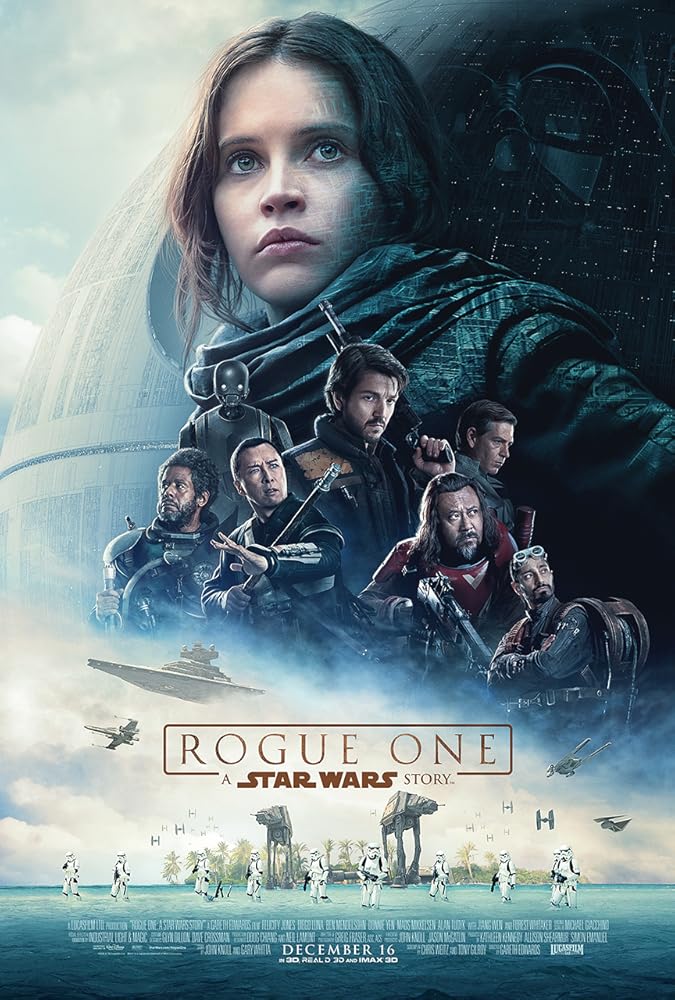
Rogue One (2016)


Rogue One is the latest entry into the Star Wars canon.  It begins with the story of Jyn Erso (Felicity Jones), daughter of Imperial scientist Galen Erso (Mads Mikkelsen).  Imperial forces appear at the Erso home to coerce Galen into continuing his work on the Death Star.  Jyn escapes and is sent into hiding, watched over by Galen's trusted friend, Saw Gererra (Forest Whitaker).   Years later, she is rescued from Imperial arrest by Captain Cassian Andor (Diego Luna) and K-2SO (voiced by Alan Tudyk), a reprogrammed Imperial droid.  Jyn is taken to meet the rest of the Rebellion soldiers, but doesn't want to get involved.  If she is able to find Saw Gererra, who is now a dangerous political extremist, the Rebellion will consider the debt repaid.  This leads Jyn to a fateful meeting with Saw, in which she discovers her father was, in fact, a Rebel sympathizer, and has built a flaw into the Death Star, the new super weapon of the Galactic Empire.  Banding together with a few other Imperial deserters and outcasts, the new team disobeys Rebellion orders and follows this trail to the planet Scarif, where they begin a guerilla operation to steal the Death Star plans and make sure the Rebellion has them before it's too late for the galaxy.  
One of the notable elements of Rogue One is that it doesn't begin with the standard Star Wars prologue text crawl.  I think this is appropriate, as Rogue One a different sort of movie.  It has much more in common with a classic war movie than any chapter of the Star Wars saga.  The presence of the Death Star throughout the movie reinforces the feeling that no one is safe, and that the Empire has the upper hand in the situation.  Even as a fan, knowing how things would eventually end up, watching Rogue One was an emotional experience.  The characters are all likable in different ways, and it's almost difficult to watch certain scenes, as you don't want to see any of them harmed. 
Each member of the cast brings their own interestingly distinct character to life on screen.  Felicity Jones does very well in the role of Jyn Erso, a woman struggling to trust others, as well as come to terms with her father's actions.  Forest Whitaker is also very memorable as the mercurial and dangerous Saw Gererra.  In addition the the great heroes Rogue One provides, there are also the classic villains of the Star Wars franchise.  James Earl Jones returns as Darth Vader, but I was most impressed with another returning character.  In an astounding feat of movie magic, effects team ILM brought Grand Moff Tarkin (the late Peter Cushing) back to the screen.  While some have complained about this use of effects, I initially thought it was an incredible makeup job rather than CGI effects.  Of course, Tarkin has always been one of my favourite minor Star Wars characters, so perhaps I'm biased.  The next down the Imperial chain of command is new character Orson Krennic (Ben Mendelsohn).  I found his character a little puzzling.  While Krennic does show anger and a thirst for power, he doesn't really cut an impressive figure next to the likes of Darth Vader or even Tarkin.  At times, Krennic looks rather incompetent, although, perhaps that's the whole point.  In any case, it's a minor complaint and doesn't spoil the film for me.
Rogue One is big and exciting, like any Star Wars movie.  The difference is in the serious atmosphere the story creates.  The Jedi mysticism we've seen before is not visible here, replaced by the blood and smoke of warfare.  While it may not be for everyone, I found Rogue One to be a welcome departure from the familiar structure Star Wars has built.

Monday, November 7, 2016

Read This! - Letter 44 (Vol. 1)


Read This! is made possible by The Gauntlet Comics and Games

Published by Oni Press, Letter 44 is tells the intriguing story of President Stephen Blades.  Shortly after his inauguration, he finds a mysterious letter in the Oval Office.  The letter, written by the previous president, tells Blades about a secret government space mission.  This mission has had next to no contact with Earth for the past several years.  While Blades goes about taking the steps to contact and learn more about the team of soldiers and scientists, the crew of the Clarke has more immediate things to deal with.  The discovery of a gigantic alien vessel complicates things, as does the pregnancy of a key member of the team.  Meanwhile, certain groups are aiming to keep the president in the dark about what's going on, and are taking drastic measures to make sure the public doesn't know.
Charles Soule (current writer of Daredevil) does a great job with this story.  It's well balanced between the space exploration and the political cloak-and-dagger tale.  Soule has a knack for tension and keeping the reader guessing.  As a reader, you're never quite certain you have everything figured out.  When you feel as though you have a handle on the situation, something completely unexpected will happen, leaving you to puzzle over how these new events fit into the bigger picture.  The art style of Alberto Jimenez Alburquerque fits quite well with the story.  Each character design is distinctive, so it's always clear who's who, which is very important with the sizable cast Alburquerque has to work with.  As well, his attention to facial expression helps to humanize the characters.  The art of the space scenes is especially well done, and communicates the feeling of zero gravity better than any space comic I've read in a while.
If you or someone you know is into science fiction and/or political thrillers, this is exactly the book you're looking for.  There are a few other volumes in this series as well, so now's a great time to get that Christmas present for the comics fan on your list!  The Gauntlet Comics and Games has got what you need.  Tell them Dave sent you!

Tuesday, October 11, 2016

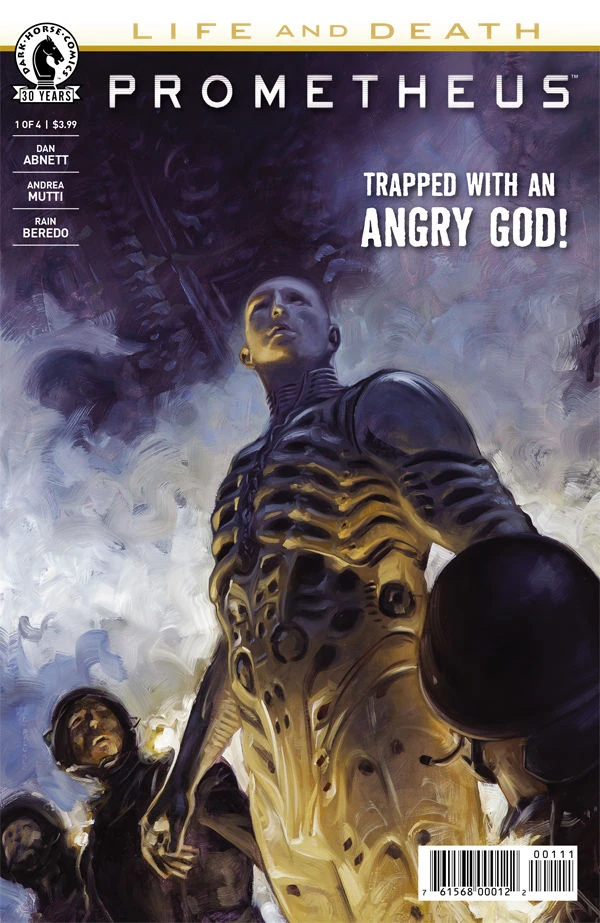
Read This! - Prometheus: Life and Death


Read This! is made possible by The Gauntlet Comics and Games

I was unaware when I picked it up, but Prometheus: Life and Death is part of a larger collection of crossover stories by Dark Horse Comics.  Together, the Life and Death minis bridge the gap between the Alien and Predator universes, and judging by the Prometheus entry of this series, it's done fairly well.
The story, set near the time of the film Aliens, as opposed to Prometheus itself, concerns a team of Colonial Marines who have commandeered an alien ship (a Predator ship, to be exact, though they don't know this), but are faced with unexpected dangers when a member of the near-invincible race known as the Engineers is awakened on board.  The Engineer takes control of the ship and brings it to the planet known as LV-233, home of the Engineers.  While on the planet, the Marines band together with a small band of survivalists (and one very unlikely ally) who are defending their xenomorph infested outpost.  From this point, they devise a dangerous, all-or-nothing plan to get a ship and escape the planet.
Visually, the art of Andrea Mutti and Rain Beredo matches well with the concept art H.R. Giger provided for Prometheus and the original Alien films.  My only complaint is there are a few panels where the xenomorphs have been depicted as having eyes.  It's clear that writer Dan Abnett has a feel for what these films represent.  There is a definite feeling of dread as you read through the story's events, and the moments of violence and horror punctuate scenes very well.  There is some amount of character shown, though much of it takes a backseat to the action.  As in the films, Abnett reinforces the idea that we're following the journey of a few regular military grunts who just want to get out alive and go home.
Prometheus: Life and Death is a short, but entertaining adventure in the Alien/Predator universe.  The surprising amount of backstory leaves me wanting to check out the other pieces of this series, as well as past comics material Dark Horse has put out over the years.

Tuesday, September 27, 2016

Mr. Nobody (2009)


Mr. Nobody is the surrealistic tale of a man known as Nemo Nobody.  Some time in the distant future, the one hundred and eighteen year old Nemo is now the last living mortal on Earth. (humans having discovered medical immortality)  A reporter secretly finds his way into his hospital room in order to interview him and find out the details of his life.  Nemo tells the story of his three distinct lives, insisting that they all happened.  We witness the different ways his life unfolds with Elise, Anna, and Jean, each of whom were married to him.  As the stories play out in jumbled bits and pieces, things slowly become stranger and stranger.  Finally, we are led to a final explanation that makes everything, impossible as it is, make sense.
Mr. Nobody is, at its heart, an experimental art film.  This is evidenced by the number of awards it won on the European film festival circuit, and the lack of attention it received in North America.  The visuals of the film echo other similar works such as Terry Gilliam's Brazil, or the dreamlike works of David Lynch.  This dreamlike quality even carries into the camera work itself.  Some scenes are prone to shift in and out of focus, or to run in reverse, reinforcing the confused nature of the narrative.
The narrative itself is good, but also frustrating for those who expect a traditional story.  At about the midway point, I found my attention wandering.  This was simply because of the slow paced and confusing nature of the story.  There is no way to tell what is truth or fiction, and because of this, I found it incredibly difficult to become emotionally invested in any character.  This is not to say that the cast doesn't deliver a solid performance, however.  Jared Leto does quite well with such a challenging role.  This is helped by a top rate makeup department, who provided some of the most captivating, realistic looking age makeup I've seen in some time.  My only true criticism is that Nemo appears to magically lose his British accent when he becomes an adult, though the plot does have a built in excuse for any inconsistencies.  Of the three wives in the film, Sarah Polley delivers a frighteningly believable performance as a woman suffering from an extreme form of bipolar disorder.  Acting-wise, I think Polley's scenes are some of the best in the entire film.
As the film descends into more dreamlike surrealism, the intent of the film as an art piece becomes much more clear.  These sequences are the most visually interesting, and a welcome change of pace from the rest of the film.  I found the final revelation of the film quite satisfying, but I can completely understand how it might leave many viewers frustrated.  As I said at the beginning of this review, Mr. Nobody is an experimental film about memory and choices.  On that conceptual level, it works remarkably well.  Unfortunately, in the terms of a traditional narrative, it's incredibly difficult to like or care about the characters.  So, if you choose to see Mr. Nobody, it's important to go in with the right expectations, or else you're going to be sorely disappointed.  If you're a fan of the unusual in film, or like to challenge yourself with your media, this will be right up your alley.  If you prefer your stories to have a proper beginning, middle, and end, this probably isn't for you.

Thursday, September 1, 2016

Snowpiercer (2013)


Snowpiercer takes place in the not-too-distant future, in a world where attempts to stop global warming have gone horribly wrong, and the Earth as we know it has been frozen solid.  What remains of humanity has been left to circle the globe (for generations) on a gargantuan train named Snowpiercer.  In the time the the train has been in operation, the system of government has become corrupt and murderous.  While passengers in the rear of the train are beaten and served slabs of black gelatin, the elite people towards the front are treated to the luxuries of steam baths and sushi. When low-class citizens Curtis (Chris Evans) and his friend Edgar (Jamie Bell) decide they've seen enough, they organize a revolutionary group to get to the front of the train in order to confront Wilford (Ed Harris), the mysterious figurehead and operator of Snowpiercer.  Along the way, they encounter both political and physical resistance, until they are finally faced with the monstrous realities of how the train operates, as well as being faced with an impossible choice that affects all the lives on board.
The production design of Snowpiercer is brilliant from top to bottom.  It makes great use of the techno-industrial ghetto aesthetic used in such films as the Matrix and Alien franchises.  Almost immediately, the film gives you a very clear sense of place.  This feeling also serves to reinforce the ideals of the characters.  We understand why they want out of the place they're in because we're shown how awful it is.
Equally important to this theming is the costume design.  The uniforms of the train guards call to mind soldiers of Nazi Germany.  Train overseer Mason (Tilda Swinton), on the other hand, wears clothing that would have been highly fashionable in the 1980s.  John Hurt's Gilliam wears patched, sooty clothing, concealing his artificial limbs, which are themselves cobbled together from canes and various scrap metal.  These costume choices are not only wonderfully made, but they solidify the idea of the class system, which is a key theme of the film.
Snowpiercer is just as well made behind the camera.  Director Joon-ho Bong (credited as Bong Joon Ho) brings a totally unique combination of techniques to this film.  Both the camera work and lighting seem to magnify the emotion of the actors, which makes the story all the more thrilling.
The acting is brilliant across the board.  Chris Evans is a picture of grim determination, in a performance which only gets more intense as we approach the ending.  Tilda Swinton displays a bureaucratic tyranny that might remind one of Margaret Thatcher's iron-clad vision for England in her time as Prime Minister.  While John Hurt's role has less screen time, he plays it with a depth and believability that is unmatched.  Also of note is Kang-ho Song as Namgoong Nimsoo, the drug addicted security expert who is drafted to get Curtis' team to the front of the train.
I was somewhat surprised at the amount of violence in Snowpiercer, but I found that it was well handled, if slightly graphic.  This approach to violence works in much the same way it does in Quentin Tarantino's Kill Bill.  The violence serves to drive the plot forward, as well as reinforce the grander themes in play.
Snowpiercer is a film with many faces.  You can watch it as a thoughtful art film, or simply as a great piece of sci-fi action.  It's thrilling in its originality, and in my opinion, it is one of the most smartest sci-fi films made in the past decade.  If you haven't seen it yet, do yourself a favour and check it out today!


Monday, August 29, 2016

Read This! - Black Science (Vol. 1)

For those of you who don't know me, I've been into comics for several years.  I enjoy the great stories and artwork that can be found in comics, and I'm always quick to talk about my favourite writers and artists.  So, in partnership with my local comic shop, The Gauntlet Comics and Games, I will be presenting occasional reviews of various graphic novels for those who might be interested.  For my first edition of Read This!, we'll be looking at Black Science, published by Image Comics.


The first thing I noticed about this book was the artwork, by Matteo Scalera and Dean White.  The sharp, bright colours against dark backgrounds draw you into a world that looks like some kind of nightmarish black-light poster.  Additionally, the sketchy panel outlines and light ink spatters reinforce the feeling of a world that's slowly disintegrating, which ties in excellently with Rick Remender's story.
The story follows the adventures of one Grant McKay, founder of a group of anarchist scientists who are working on interdimensional travel and exploration.  Unfortunately, as often happens in these kind of stories, something goes horribly wrong, and it's up to Grant and his team to get back home safely, and keep his children safe.  As the story progresses, they travel from world to world, encountering numerous dangers while also trying to uncover which member of the team sabotaged their mission.  Various flashbacks provide context of the relationships of the characters as well as possible clues to who the traitor is.
This comic uses some of the best elements of pulp sci-fi, while still keeping things original.  For instance, one of the worlds the team encounters early on is populated by German World War I soldiers in the middle of a battle with a technologically advanced tribe of Native Americans.  There are also all manner of futuristic equipment and strange life forms to feast your eyes on.
While Black Science draws on pulp influences, it isn't so clear-cut as far as good and evil.  Just about every character in this comic (minus the kids) has reasons for what they're doing.  It's entirely in the eye of the reader as to whose decisions are right or wrong.  The fact that each character is still three-dimensional and sympathetic even in such moral grey areas is a testament to the writing ability of Rick Remender.  Even when you think a character is making the worst decisions possible, you can understand them, or even identify with their logic.
I won't go into details of the ending, but I will only say it left me wanting more.  Black Science gives us a very interesting look at ideology and personal choice against an incredibly vibrant, endless canvas of sci-fi worlds.  If you're getting bored with typical good vs. evil superhero books, but still want a bit of fun in your comics, Black Science is a great place to start.

Tuesday, August 16, 2016

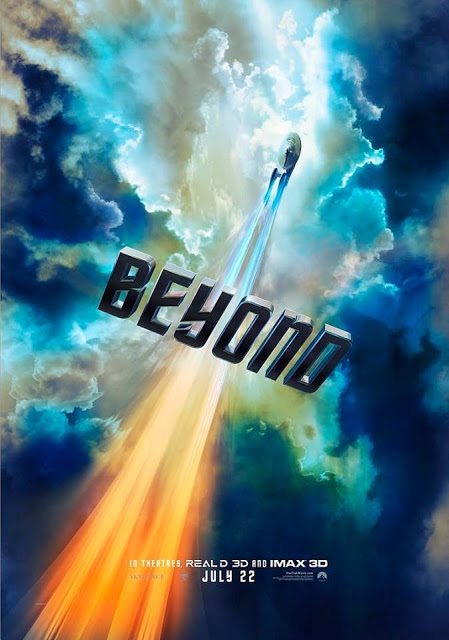
Star Trek: Beyond (2016)


**Warning: mild spoilers ahead!**

This year marks the 50th anniversary of Star Trek, thus it's appropriate that there is more talk of it in the media than ever before.  As well as the ongoing development of the new TV series, Star Trek: Discovery, we have Star Trek: Beyond, the latest in the J.J. Abrams produced Trek films.
The sequel to 2013's Into Darkness begins, interestingly enough, with an ending of sorts.  After investigating a seemingly normal distress call in an unknown part of space, the crew of the Enterprise is ambushed by a new and violent force that basically tears the ship to pieces.  With no choice but to abandon ship and crash land on the nearby planet, we follow the dangerous journey of the crew, who have now been separated, and are left to locate and each other on a hostile planet.  To make matters worse, they are also being hunted by the vicious alien warlord, Krall, who has captured Uhura and Sulu along with several other members of the Enterprise crew.  A daring rescue operation is orchestrated, which then turns into a chase that concludes in a climactic action scene on and around the space station Yorktown, where we witness the final battle of Krall and Kirk.
Unlike some other Star Trek films before it, this one leans much more toward action than philosophy.  In this sense, it is accessible for newcomers to the series, though people who are interested in more detail of the Star Trek universe might be better to check out the 2009 reboot before getting into this latest offering.  The film expects the audience to be up to speed more or less from the get-go, but the action is almost immediate, which leaves little room for explanations outside of some brief snippets of exposition in dialogue.
It is a very exciting movie experience, though there are some flaws.  In some scenes, there is simply so much action that it's difficult to make sense of what was happening on the screen.  In addition, the general darkness of many scenes as well as the constantly swaying, simulated gravity of the cinematography made some scenes a bit less satisfying than they could have been.  My wife and I didn't see this in 3-D, but I feel that's for the best, as the motion of some of the scenes made her feel a bit on the queasy side.
Apart from these minor complaints, Star Trek: Beyond is a very enjoyable film.  Prop and production design was top-notch, as it has been with the previous instalments of this series.  The makeup design in particular was exceptionally good.  Every alien looked properly organic and realistic within the world of the movie.  As well, the design of the makeups still allowed for a wide range of expression on the characters, Krall in particular.
The score, by Micheal Giacchino, recalls many classic moments of the original TV series, while still making room for some more original sounds.  In addition, a few tracks of modern music (I won't spoil the surprise of their purpose here) add some very interesting contrast to one of the final action scenes.
As this is an action heavy movie, it would be irresponsible of me not to mention the excellent fight choreography and stunt work.  There were a great amount of stunts done in this movie, and I have great respect for the individuals who helped make this movie so exciting to watch.
As important as these elements are, a film needs stars, and Beyond is packed with them.  Just about every member of the cast gets a moment to shine, all the while keeping a balanced amount of screen time.  No one actor seems to overshadow another, which can be a difficult thing to accomplish in a film with such a large cast.  If I had to pick any standouts, I would choose Simon Pegg (also a co-writer of the screenplay) as Scotty, who interacted wonderfully with Sofia Boutella as the scrappy alien survivalist Jaylah.  There's a clear kinship between them onscreen, and their scenes together are delightful to watch.  Acclaimed actor Idris Elba is chillingly ruthless as the warlord Krall.  His performance is all the more impressive for communicating such emotion through his elaborate makeup.  Finally, it's difficult not to give extra attention to Anton Yelchin as Chekov after his unfortunate death earlier this year.  His enthusiastic performance feels somewhat bittersweet in knowing that this was his last film.
Despite a few technical flaws, I came away from this movie excited, wondering what new adventures the crew of the Enterprise will be having in the next film.  As I mentioned at the beginning, this could have easily been a much different film, but Star Trek: Beyond clearly defines itself as fun!  It's this kind of attitude towards the franchise that will win new fans who have felt alienated by the pseudo-science and long, philosophical conversations of previous films and TV episodes.  Make no mistake, science and big ideas have always been the hallmark of Star Trek, but Beyond starts from the same place of excitement the original series did.  It makes playful jokes about itself, while still acting out moments that feel pulled straight from the original series.  It captures our sense of imagination and adventure, and from this jumping-off point, we can begin to explore the bigger ideas at work.  In this film, the great ideals of peace and unity stand out clear as day through the actions of the Enterprise crew.  As Gene Rodenberry intended with the original series, witnessing these heroic actions on the big screen inspires us to look beyond, and to aspire to become something greater than ourselves.  In times as worrying as these, it's a message I hope people will carry with them outside of the theatre.

Sunday, August 14, 2016

Stranger Things (2016)


Set in the mid-1980s, Stranger Things follows the mystery of Will Byers, a boy who mysteriously goes missing, leaving his friends and family to deal with grief, strange supernatural happenings, a monster, and the lingering question of if Will is truly still alive.  I would explain more, but to do this would be a disservice to this fantastically made show.  If you're not at least a little interested by the end of this review, chances are it isn't for you.
The newest sensation on Netflix is a curiously familiar beast of a show, yet is completely original.  In large part, this familiarity is due to the setting of the show itself.  For people in my age bracket (I refuse to be labelled as a 'millenial'), it evokes feelings of the pre-internet age in a way that no show has done before.  Some cynics might say that this is simply a cash-in for the VHS-hipster crowd, but I am firmly on the opposite side of that argument.  While the show makes references liberally, nothing about it ever feels artificial.  Series creators the Duffer Brothers have paid very close attention to the details of production design on Stranger Things, and it proves that they have the same feelings of nostalgia we do as viewers.  In an increasingly digital world, Stranger Things helps to recall comforts we'd long forgotten.  Even the title sequence is packed full of details that instantly trigger buried memories of the past.  The intermittent fuzz of VHS grain reminds us of a time of video stores and recording shows from television.  The title font itself carries its own presence, perhaps reminding us of old Dungeons and Dragons manuals, or the teen horror novels of Christopher Pike and R.L. Stine.
The casting is phenomenal, and has some of the best kid actors (played by Finn Wolfhard, Millie Bobby Brown, Gaten Matazarro, and Caleb McLaughlin) I've seen since J.J Abrams' Super 8.  They play well against each other, and, more importantly, they look and act as you'd expect real 12 year olds to.  It's a very refreshing thing to see when many other programs have token kid actors who simply seem to read a script and look good on screen.  Stranger Things isn't afraid to have kids who don't look like they've stepped straight out of the Sears catalogue, and this is a huge part of the show's success.  These kids reminds me of kids I grew up with, and it makes me care for each one of them as if I knew them personally.
The adult cast is equally talented.  David Harbour is very good as the down-and out police chief Jim Hopper, but I was especially impressed with the performance of Winona Ryder as Joyce Byers, Will's grieving mother.  I normally don't care much for Winona Ryder, but I found her completely believable playing the slowly unravelling mother of a missing child.
The tone of the show varies by episode, but there is a current of nostalgia running throughout.  The show uses hints of various iconic TV shows and movies, all the while keeping an original and engaging story.  There are heavy references to John Carpenter's The Thing, The X-Files, Twin Peaks, and E.T., among others.  This mix of elements ensures that there's an even balance of nostalgia and terror.  This deliberate design for the show carries over to effects as well.  Where possible, the producers have used high quality physical creature effects over CGI, which lends a chillingly visceral feel to the horror elements of the show.  As well, in the tradition of the best horror films, these effects are used minimally.  You only ever get brief glimpses of things, leaving your imagination to craft the most horrific parts.
I'm hesitant to give away any details of the storyline, but suffice to say it contains realistic family drama, surprises upon surprises, and a deep reaching conspiracy.  As of this writing, I am roughly halfway through the eight episode run of the first season.  I have a few theories about what's truly going on, and I am looking forward to discovering what I got right and what I didn't know.
The beauty of Stranger Things is that it's made up of so many different parts, many people can watch and like it for completely different reasons, all of which are valid.  It also reminds us of a simpler time, and this enhances the horror when we're shocked out of our own nostalgia.  It's a fantastic show, and I hope it continues for years to come.  Now, if you'll excuse me, I'll be in my blanket fort watching the late-night monster movie marathon.