Showing posts with label horror. Show all posts

Monday, May 29, 2017

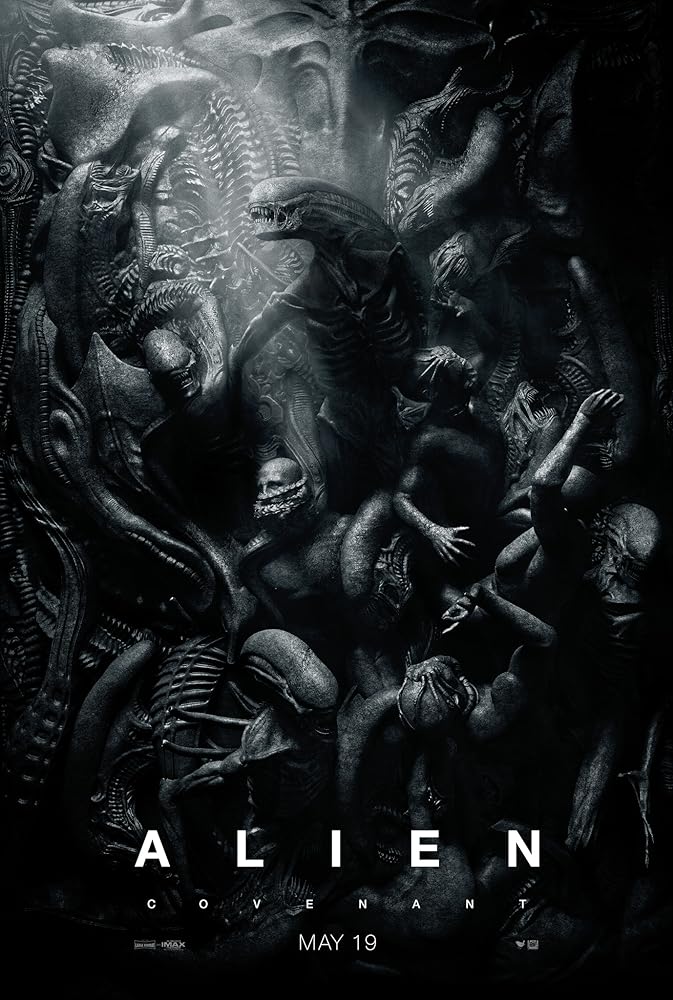
Alien: Covenant (2017)


Alien: Covenant, the follow-up to Prometheus (2012) begins with a disaster on board the colony ship Covenant, bound for a new and distant planet.  Many of the colonists and crew are killed, but there is a glimmer of hope in the discovery of a much closer Earth-like planet.  The crew decide to examine the planet closer, and make some startling discoveries.  After some horrifically disastrous contact with a dangerous alien spore, the Covenant's crew are taken in by the android David (Michael Fassbender), last survivor of the Prometheus.  The crew discovers that in his time on the planet, David has become something of a Dr. Moreau type, experimenting with the title creatures and refining them into the fearsome killing machines we see in later films.  After this point, the movie follows some familiar patterns, as the crew on the planet fight to survive while the others still aboard the Covenant desperately try to make contact with them.
As befits Ridley Scott's return to the Alien franchise, Alien: Covenant contains a good helping of thrills and tension, as well as a few gruesome shock scenes.  While the crew of the Covenant don't have the deepest characters in cinema, there is enough detail to make them distinctive and memorable.  In particular, I enjoyed watching Daniels (Katherine Waterston), who seems built for a crisis situation, and shares many personality traits with the more famous Ellen Ripley.  Also notable is acting-captain Tennessee (Danny McBride), who goes through a range of emotions over the course of the movie.  Finally, Michael Fassbender gives a very impressive performance, playing both David and the Covenant's android crew member Walter.  Although the two characters are essentially the same, Fassbender plays them with enough variation that they appear different in subtle ways.
The visual effects are about what's to be expected for an Alien film, although it does seem to lean a little more on the side of CGI effects over the physical element.  That being said, it makes the scary moments no less scary for it.  This atmosphere is helped along by the moody, synthetic sounding score of Jed Kurzel.
There are some philosophical and religious undertones to Covenant, but they seem to serve as a framework that the film is built on rather than communicating any sort of deeper message. (apart from the obvious 'don't play God' themes)  This is a welcome relief and contrast from the uproar Prometheus caused in some political/religious groups back in 2012.
If you were to ask me if Alien: Covenant is a good movie, I'd say yes.  However, if you were to ask me if it's better than Alien, I would question the reasoning of your comparison.  The fact is, there is never going to be another movie that matches the tone and style that Alien created, as much as some fans might want that.  Alien: Covenant is a good piece of sci-fi horror, and an interesting addition to the Alien canon.  Of course, if you'd rather just see Alien again, I suggest you stay home and let other people enjoy the movie.

Tuesday, April 18, 2017

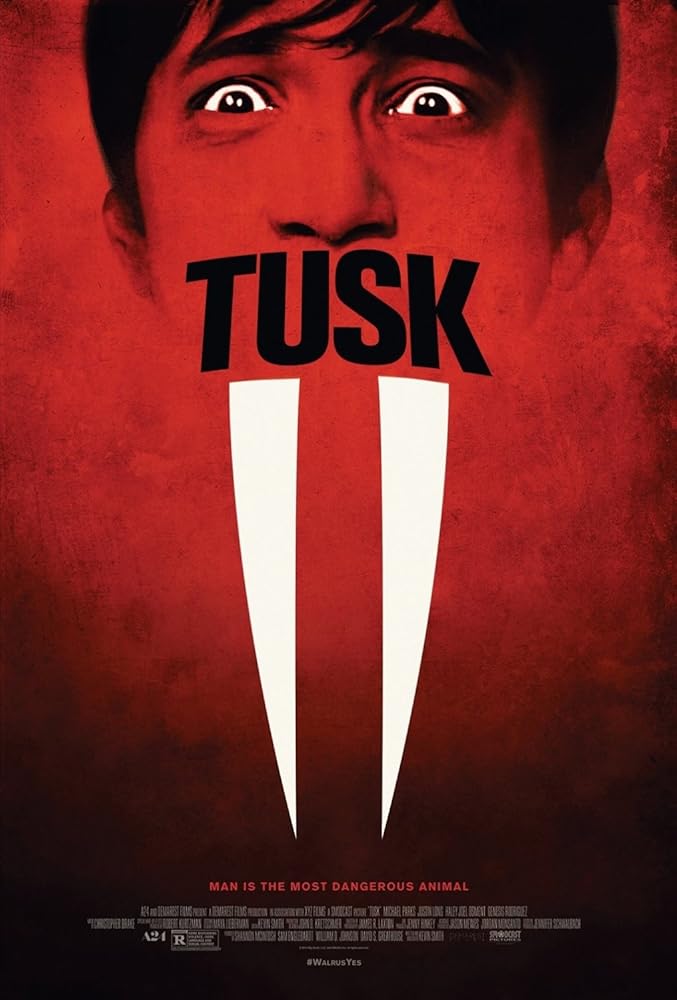
Tusk (2014)


Tusk, the second horror feature for director Kevin Smith, follows the story of Wallace Bryton (Justin Long), a shock/lowbrow podcast host.  When a lead for an interview in Canada unexpectedly falls through, Wallace investigates a mysterious flyer he comes upon by chance.  The advertisement leads him to one Howard Howe (Michael Parks), who has a strange, yet fascinating life story.  Soon enough, it becomes clear that Howe is not the man he seems, and is using Wallace as his latest test subject to create some sort of human/walrus hybrid.  Meanwhile, Wallace's partner Teddy (Haley Joel Osment) and his girlfriend Ally (Genesis Rodriguez) realize something is very wrong.  They team up with detective Guy Lapointe (Johnny Depp) to track down Wallace and find out the horrific truth.
Initially, I was drawn in by Tusk's expertly crafted trailer.  Unfortunately, the film itself is not nearly as serious as the trailer makes it out to be.  Tusk is one of those peculiar films that is hard to classify in terms of genre.  It's not quite scary enough to be a true horror film, but not quite funny enough to be a comedy.
For me, I think a lot of the emotional disconnect comes from the characters themselves.  Although one does feel some amount of sympathy for Wallace in his situation, it never really goes beyond a surface level.  Ultimately, Wallace is not a very likeable guy.  It's also difficult to piece together his personal feelings, since he spends the final half of the film shrieking incoherently.  This further complicates the intended audience reaction when we come to the revelation that Ally is cheating on Wallace with his podcast partner Teddy.  There is some initial shock, but it wears off quickly.  Even though the two are obviously doing wrong, Teddy seems to be a genuinely nice guy (perhaps even a better man than Wallace), so it becomes a bit of a mental exercise to imagine him being the villain.
Speaking of villains, the greatest performance in Tusk absolutely belongs to Michael Parks, who also appeared in Smith's previous horror film Red State.  Much of his screen time is taken up with storytelling, and it's here that Parks shines.  His words cast a kind of dreadful hypnosis on the audience, and then, in the blink of an eye, the kindly old Howard Howe has transformed into a raving lunatic.  It's a change that's all the more terrifying because we realize that we were fooled as much as Wallace was.
Johnny Depp's part in Tusk highlights all of my issues with the film.  Depp chews the scenery as the almost cartoonish Quebecois detective Guy Lapointe.  It's funny for a few moments, but then we're subjected to a very long, almost pointless story of how Lapointe unknowingly encountered Howard Howe some time earlier.  It's a long time to wait for exposition that isn't truly needed, and really drags down the pacing of the film.  Guy Lapointe is really nothing more than a plot device, and not a very good one at that.
Another issue the film has is with the effects makeup/prosthetics.  While the suit is well crafted, it's so outlandish and grotesque that it's nearly impossible to take seriously.  But, perhaps it was never meant to be serious in the first place.  
While I didn't have the luxury of research going in, it does help to understand that Smith made this film more or less for a laugh.  Tusk was the product of a bizarre conversation from Smith's SModcast program, which he ultimately decided to make into a film, just because he could.  Knowing and understanding this is key to the enjoyment of a film like Tusk.  Tusk doesn't work as a true horror film, but if you put it into the same category as, say, Creepshow, or the Tales From The Crypt series, it becomes quite obvious the tone Kevin Smith was aiming for, and you'll be able to enjoy it without focusing on the flaws.  

Monday, October 24, 2016

House On Haunted Hill (1959)


Prior to this writing, my only experience of this film was the 1999 remake, which I saw around this time some years ago while recovering from dental surgery.  I remember it being serviceable, but not particularly good or memorable, as is the case with many remakes.
The original House On Haunted Hill begins in a jarring, but effective way.  A black screen is presented, followed by a number of sounds, such as rattling chains, and blood-curdling screams.  Then, out of the blackness appears the head of Watson Pritchard (Elisha Cook Jr.), warning the audience of the harrowing experience that awaits them.  After this, we're introduced to the rest of the cast, via the narration of eccentric millionaire Frederick Loren (Vincent Price).  Loren has offered five guests a chance at ten thousand dollars if they are willing to spend the entire night in a haunted house, along with him and his wife.  Of course, things aren't quite as simple as this, as Loren's wife Annabelle (Carol Ohmart) is planning to murder her husband that night.  The guests are each given a gun 'for protection', and are left to defend themselves from the threat of the supernatural, as well as each other.
Technically speaking, House On Haunted Hill was ambitious for its time, but the effects are laughable by today's standards.  Thankfully, the film takes a greater focus on the paranoia caused by the hauntings, rather than the spirits themselves.  There is a great deal of storytelling surrounding the house's dark history that serves to build atmosphere and builds the tension for the scares that follow.  The cast does a good job of performing the terror of the situations, but it's clear from the beginning that Vincent Price is the star.  His scenes with Carol Ohmart are particularly good.  Price has a way of reading a line that might seem romantic drip with murderous subtext.  Ohmart provides the prefect foil for his sinister character, and responds in kind with a coldness and dark subtext of her own.
I didn't find myself particularly surprised by any of the film's events, but I think this is a case of personal context more than anything else.  House On Haunted Hill uses several horror tropes that by today's standard seem cliched and common, but in 1959, these were likely a little fresher to horror audiences.  For that reason, I think it stands as one of the more important films in the 'haunted house' sub-genre of horror.  If you don't mind a few campy effects and are looking for a decent scare leading up to this Halloween, this is a good place to start.

Tuesday, September 20, 2016

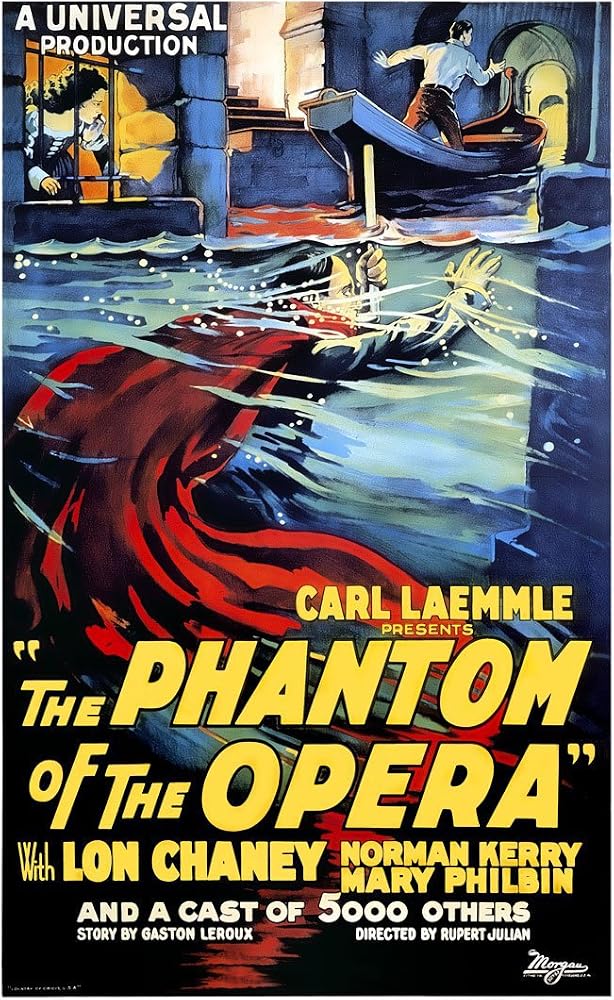
The Phantom of the Opera (1925)


First, a few words about silent films:
Considering the advances in film technology over the past century or so, it can be difficult to appreciate the simpler form of silent film.  I find it helps to remember the context of the time period.  Back in the 1920s, the art of film was in its infancy.  Directors had no true idea what would work for any given audience, and so films were made to appeal to the broadest audience possible.  In addition, film was able to transport audiences and give them experiences that were simply not possible with other mediums like books.  This means that by today's standards, silent films often have shots that seem to linger far too long, or performers who appear to be constantly overacting with their facial expressions.  However, if you can look past these things, and allow yourself to be absorbed with the story, you may begin to discover some of the foundations of great filmmaking.  As 2011's The Artist taught us, there was a reason motion pictures became popular, even without the use of sound.

The Phantom of the Opera, based on the classic novel by Gaston Leroux, concerns a mysterious patron of the Paris Opera House.  He begins to make strange demands of the casting of the operas, and things take a sinister turn when his demands are not met, and people end up dead.  Many believe the opera house is cursed or haunted, but these mysterious happenings are the work of a man known only as 'the Phantom' (Lon Chaney).  He takes a special interest in the singer Christine Daae (Mary Philbin), and lures her into his lair underneath the opera house.  There, she discovers that the Phantom wants to have her star in an opera he has composed.  However, she also makes the discovery that he is hideously deformed.  The Phantom allows her to leave one last time, but only on the condition she leaves her lover, the Vicomte  Raoul De Chagny (Norman Kerry).  Christine refuses his demands, and as a result is kidnapped and held hostage by the Phantom.  What follows is a daring rescue mission organized by Raoul along with the French police and opera staff to stop the Phantom's plans before he destroys the opera house.
This film makes great use of large sets, giving the story an appropriately grand feeling.  The costuming is also excellent, particularly in the masked ball scene.  You get a true feel of the decadence of the era shown onscreen.
Unlike the more sentimental Andrew Lloyd Webber version, this film pulls no punches concerning the grotesque nature of the Phantom.  In fact, Mary Philbin's Christine appears to be thoroughly horrified by the Phantom even before his unmasking.  The makeup is, of course, one of the biggest talking points of this film.  While he went uncredited for it, it is now accepted knowledge that Lon Chaney created his own makeup for this film.  The skull-like face is still considered one of the most accurate depictions of the Phantom as described in the book.
One of the most important legacies of The Phantom of the Opera lies with its star, Lon Chaney.  He would go on to earn the nickname 'the man of a thousand faces' for his groundbreaking work and performances with makeup.  In later years his son, Lon Chaney Jr., would bring to life such classic horror characters as the wolfman.  In addition, this film was the beginning of what would become known as the 'Universal Monsters' franchise, one of the most enduring and historically important collections of horror films today.  It's unsure if Universal will return to the Paris opera house anytime soon, but with the relaunch of the franchise in the near future, it's quite possible we'll see a new generation's Lon Chaney on screen soon enough.  

Sunday, August 14, 2016

Stranger Things (2016)


Set in the mid-1980s, Stranger Things follows the mystery of Will Byers, a boy who mysteriously goes missing, leaving his friends and family to deal with grief, strange supernatural happenings, a monster, and the lingering question of if Will is truly still alive.  I would explain more, but to do this would be a disservice to this fantastically made show.  If you're not at least a little interested by the end of this review, chances are it isn't for you.
The newest sensation on Netflix is a curiously familiar beast of a show, yet is completely original.  In large part, this familiarity is due to the setting of the show itself.  For people in my age bracket (I refuse to be labelled as a 'millenial'), it evokes feelings of the pre-internet age in a way that no show has done before.  Some cynics might say that this is simply a cash-in for the VHS-hipster crowd, but I am firmly on the opposite side of that argument.  While the show makes references liberally, nothing about it ever feels artificial.  Series creators the Duffer Brothers have paid very close attention to the details of production design on Stranger Things, and it proves that they have the same feelings of nostalgia we do as viewers.  In an increasingly digital world, Stranger Things helps to recall comforts we'd long forgotten.  Even the title sequence is packed full of details that instantly trigger buried memories of the past.  The intermittent fuzz of VHS grain reminds us of a time of video stores and recording shows from television.  The title font itself carries its own presence, perhaps reminding us of old Dungeons and Dragons manuals, or the teen horror novels of Christopher Pike and R.L. Stine.
The casting is phenomenal, and has some of the best kid actors (played by Finn Wolfhard, Millie Bobby Brown, Gaten Matazarro, and Caleb McLaughlin) I've seen since J.J Abrams' Super 8.  They play well against each other, and, more importantly, they look and act as you'd expect real 12 year olds to.  It's a very refreshing thing to see when many other programs have token kid actors who simply seem to read a script and look good on screen.  Stranger Things isn't afraid to have kids who don't look like they've stepped straight out of the Sears catalogue, and this is a huge part of the show's success.  These kids reminds me of kids I grew up with, and it makes me care for each one of them as if I knew them personally.
The adult cast is equally talented.  David Harbour is very good as the down-and out police chief Jim Hopper, but I was especially impressed with the performance of Winona Ryder as Joyce Byers, Will's grieving mother.  I normally don't care much for Winona Ryder, but I found her completely believable playing the slowly unravelling mother of a missing child.
The tone of the show varies by episode, but there is a current of nostalgia running throughout.  The show uses hints of various iconic TV shows and movies, all the while keeping an original and engaging story.  There are heavy references to John Carpenter's The Thing, The X-Files, Twin Peaks, and E.T., among others.  This mix of elements ensures that there's an even balance of nostalgia and terror.  This deliberate design for the show carries over to effects as well.  Where possible, the producers have used high quality physical creature effects over CGI, which lends a chillingly visceral feel to the horror elements of the show.  As well, in the tradition of the best horror films, these effects are used minimally.  You only ever get brief glimpses of things, leaving your imagination to craft the most horrific parts.
I'm hesitant to give away any details of the storyline, but suffice to say it contains realistic family drama, surprises upon surprises, and a deep reaching conspiracy.  As of this writing, I am roughly halfway through the eight episode run of the first season.  I have a few theories about what's truly going on, and I am looking forward to discovering what I got right and what I didn't know.
The beauty of Stranger Things is that it's made up of so many different parts, many people can watch and like it for completely different reasons, all of which are valid.  It also reminds us of a simpler time, and this enhances the horror when we're shocked out of our own nostalgia.  It's a fantastic show, and I hope it continues for years to come.  Now, if you'll excuse me, I'll be in my blanket fort watching the late-night monster movie marathon.