Showing posts with label comedy. Show all posts
Monday, May 8, 2017
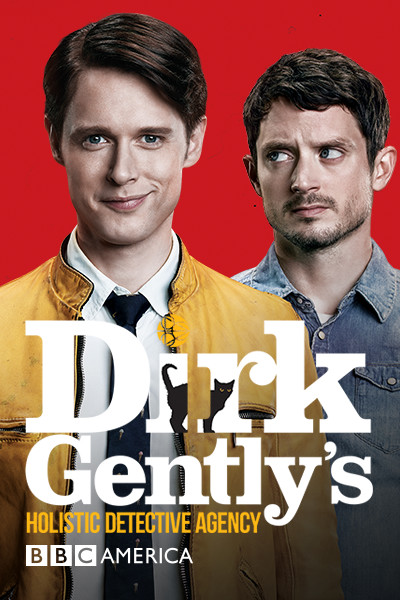
The First Three - Dirk Gently's Holistic Detective Agency (2016)
Produced by Netflix and BBC America, Dirk Gently's Holistic Detective Agency chronicles the strange investigations of the title character (Samuel Barnett), and his unwilling assistant Todd (Elijah Wood). The disarmingly friendly Dirk Gently differs from most detectives in that he uses a 'holistic' method of investigations. In practice, this means that he doesn't interview witnesses or look for clues. He simply goes about his business until he inevitably stumbles onto whatever clue unlocks the entire mystery. He meets Todd under some very bizarre circumstances, and decides Todd will be his new assistant; the Watson to his Holmes, as it were. Todd wants nothing to do with Dirk initially, but circumstances keep causing the two to cross paths, so Todd eventually resigns to his sidekick role. At the same time, another pair of real detectives, Zimmerfield and Estevez (Richard Schiff and Neil Brown Jr.) are trailing Dirk and Todd, since the pair seem to be connected to some very bizarre cold cases. Meanwhile, across the country, electrician/part time hacker Ken (Mpho Koaho) is abducted by 'holistic' killer Bart Curlish (Fiona Dourif). Her life's mission is to kill Dirk Gently, even though the two have never crossed paths. Dirk and Todd spend their time solving bizarre mysteries and avoiding death/capture, while the rest follow the trail they've left, in an exciting and strangely funny series.
For a series this unusual, the writing has to be spot on to keep the tone consistent, and it doesn't disappoint. The writers have a clear appreciation for the original Douglas Adams novels. The dialogue and plotting has all the earmarks of Adams's work, from silly arguments over semantics to odd speech patterns and out-of-the-blue weirdness. The mysteries themselves are densely layered, but manage to have surprisingly coherent solutions in spite of their outlandish nature. The production design goes a long way to helping the audience accept the strangeness of Dirk Gently's world. Everything feels just a bit off-centre from regular life, and eventually, we're drawn into the strangeness and we begin to think like Dirk Gently would. For instance, the idea of a shark attack on dry land becomes more of a brain teaser than a flat-out impossibility.
The pure strangeness of this show is brought to life by Samuel Barnett's portrayal of Dirk Gently. While the show is set in America, Dirk is English through and through, which is a nice nod to the original books. As mentioned above, Dirk is almost always cheerful and friendly to everyone, even in the middle of a grisly crime scene. It's amusing to see other characters trying to decide how to respond to his friendliness. Elijah Wood's character is very similar to the one he played in Wilfred: Todd is constantly frustrated with Dirk's actions, yet consistently winds up advancing the action whatever decision he makes. The rest of the cast are excellent as well and provide good contrast with the main players. Detectives Zimmerfield and Estevez don't have as much screen time, but they share some of the most amusing moments in the series with their hard-boiled dialogue and deadpan reactions to all the weirdness around them. For me, the standout performances belong to Mpho Koaho and Fiona Dourif as Ken and Bart. Ken seems to be a nice guy who was in the wrong place at the wrong time. His fear of Bart feels very real, and it's very interesting to watch that fear fade away as the two become uneasy friends, of a sort. Despite first appearances, Bart is a fascinatingly complex character. Fiona Dourif manages to make Bart scary, yet shows a certain sensitive side at times. Even though Bart is ostensibly the villain of this story, she becomes likeable in the strangest way.
If you like a good mystery, but are tired of the same old predictable stories, Dirk Gently's Holistic Detective Agency is the right show for you. Dirk Gently combines sci-fi elements with solid mystery structure and comedic punctuation to create a very entertaining show that defies expectations. If you haven't seen it yet, it's worth a look!
Tuesday, April 18, 2017
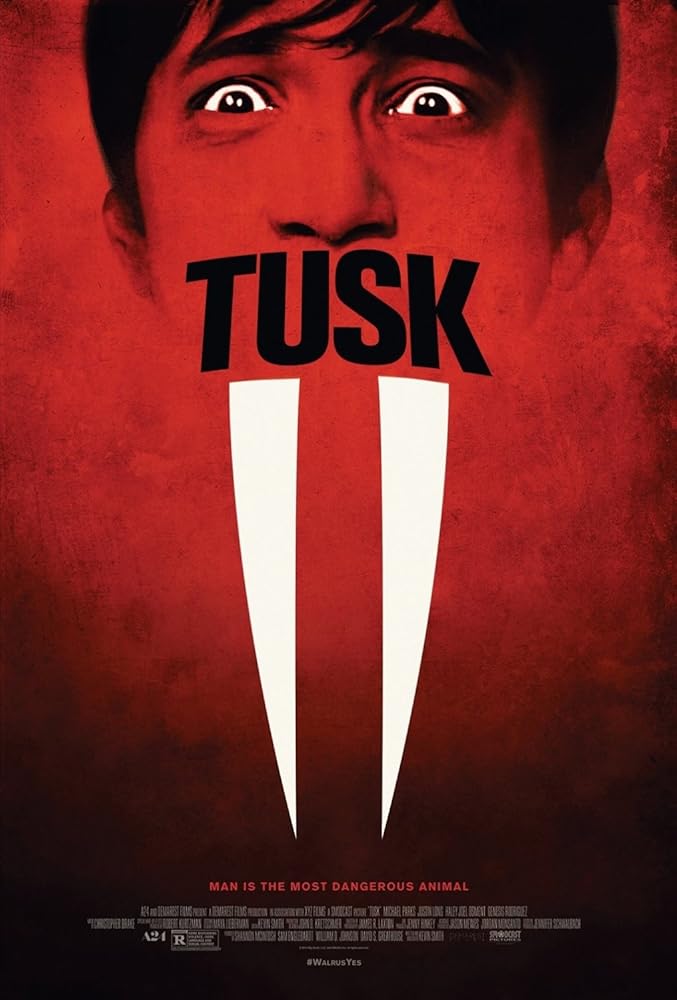
Tusk (2014)
Tusk, the second horror feature for director Kevin Smith, follows the story of Wallace Bryton (Justin Long), a shock/lowbrow podcast host. When a lead for an interview in Canada unexpectedly falls through, Wallace investigates a mysterious flyer he comes upon by chance. The advertisement leads him to one Howard Howe (Michael Parks), who has a strange, yet fascinating life story. Soon enough, it becomes clear that Howe is not the man he seems, and is using Wallace as his latest test subject to create some sort of human/walrus hybrid. Meanwhile, Wallace's partner Teddy (Haley Joel Osment) and his girlfriend Ally (Genesis Rodriguez) realize something is very wrong. They team up with detective Guy Lapointe (Johnny Depp) to track down Wallace and find out the horrific truth.
Initially, I was drawn in by Tusk's expertly crafted trailer. Unfortunately, the film itself is not nearly as serious as the trailer makes it out to be. Tusk is one of those peculiar films that is hard to classify in terms of genre. It's not quite scary enough to be a true horror film, but not quite funny enough to be a comedy.
For me, I think a lot of the emotional disconnect comes from the characters themselves. Although one does feel some amount of sympathy for Wallace in his situation, it never really goes beyond a surface level. Ultimately, Wallace is not a very likeable guy. It's also difficult to piece together his personal feelings, since he spends the final half of the film shrieking incoherently. This further complicates the intended audience reaction when we come to the revelation that Ally is cheating on Wallace with his podcast partner Teddy. There is some initial shock, but it wears off quickly. Even though the two are obviously doing wrong, Teddy seems to be a genuinely nice guy (perhaps even a better man than Wallace), so it becomes a bit of a mental exercise to imagine him being the villain.
Speaking of villains, the greatest performance in Tusk absolutely belongs to Michael Parks, who also appeared in Smith's previous horror film Red State. Much of his screen time is taken up with storytelling, and it's here that Parks shines. His words cast a kind of dreadful hypnosis on the audience, and then, in the blink of an eye, the kindly old Howard Howe has transformed into a raving lunatic. It's a change that's all the more terrifying because we realize that we were fooled as much as Wallace was.
Johnny Depp's part in Tusk highlights all of my issues with the film. Depp chews the scenery as the almost cartoonish Quebecois detective Guy Lapointe. It's funny for a few moments, but then we're subjected to a very long, almost pointless story of how Lapointe unknowingly encountered Howard Howe some time earlier. It's a long time to wait for exposition that isn't truly needed, and really drags down the pacing of the film. Guy Lapointe is really nothing more than a plot device, and not a very good one at that.
Another issue the film has is with the effects makeup/prosthetics. While the suit is well crafted, it's so outlandish and grotesque that it's nearly impossible to take seriously. But, perhaps it was never meant to be serious in the first place.
While I didn't have the luxury of research going in, it does help to understand that Smith made this film more or less for a laugh. Tusk was the product of a bizarre conversation from Smith's SModcast program, which he ultimately decided to make into a film, just because he could. Knowing and understanding this is key to the enjoyment of a film like Tusk. Tusk doesn't work as a true horror film, but if you put it into the same category as, say, Creepshow, or the Tales From The Crypt series, it becomes quite obvious the tone Kevin Smith was aiming for, and you'll be able to enjoy it without focusing on the flaws.
Tuesday, March 7, 2017
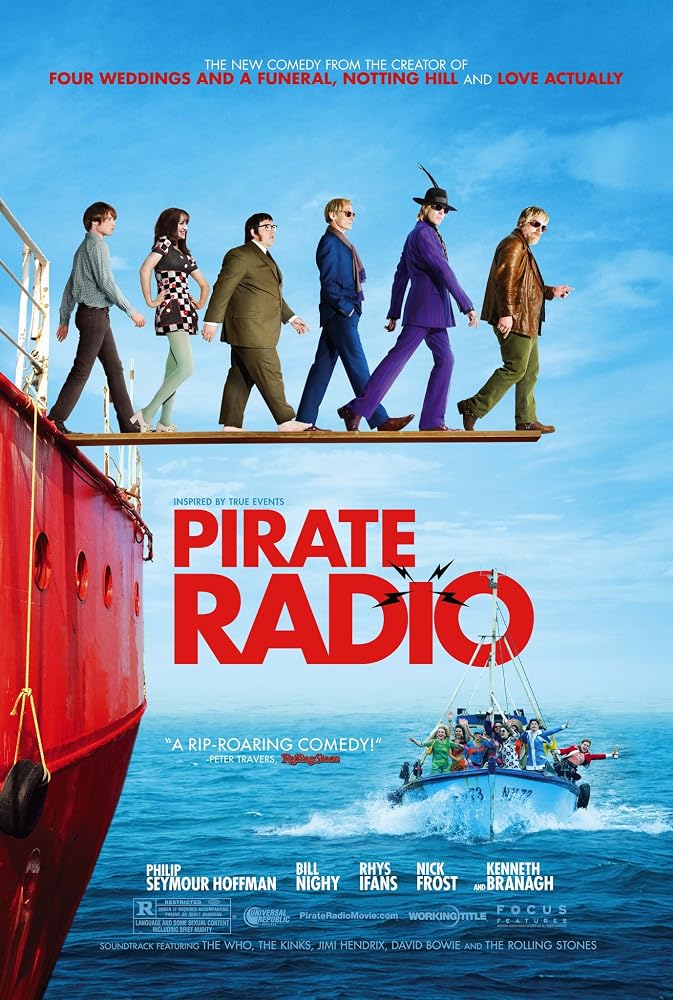
Pirate Radio (2009)
Pirate Radio (known as The Boat That Rocked in the U.K.) is based on the true story of how a handful of renegade DJs influenced the future of music forever. In the 1960s, rock and roll was incredibly popular in Britain, but it only got a fraction of airtime on the radio. A few enterprising radio people sought to remedy this, and began broadcasting 24/7 rock and pop music from ships stationed in the North Sea. The pirate station known as 'Radio Rock' was the most popular among them.
It's into this picture that we are introduced to young Carl (Tom Sturridge), who has recently been kicked out of school and is sent out to sea to visit with his godfather Quentin (Bill Nighy), the de facto manager of Radio Rock. Dave (Nick Frost), one of the many DJs on board, takes a liking to Carl, and before long the rest of Radio Rock considers Carl to be one of their own. While the DJs go through various exploits of debauchery and clashes of ego, Carl discovers one of the DJs on board may be his father, and he decides to seek him out before his return home. Meanwhile, on the mainland, Sir Alistair Dormandy (Kenneth Branagh), and his new assistant, one Mr. Twatt (Jack Davenport) are determined to shut down the noise pollution of rock and roll for good, whether it's done by legal means or otherwise. Carl eventually discovers the identity of his father, but only moments later, the entire crew are put into a life threatening situation at sea, and brought out of it in a most unexpected way.
The first thing I noticed about Pirate Radio was the amount of sexual content. While I was a bit shocked at first, it was certainly true to the era, and it would hardly be fair to judge a movie for that. The other major attribute of this Pirate Radio is that it's an ensemble film. Thankfully director Richard Curtis has done very well with other ensemble films like Love Actually. No one character ever truly feels left out of the story, even if they appear for a few brief moments. In fact, one could argue that these brief moments are more impactful than the larger set pieces of the movie. One of my favourite scenes in the film is an exchange between Carl and early morning DJ Bob (Ralph Brown). It's a very short scene with very little dialogue, but there's a great deal of emotional information packed into that little scene. I think this stands as both proof of my theory and proof of the great acting and direction of this movie.
As I mentioned above, just about everyone in this film gets their moment in the sun, and each character is memorable in their own way. One of the most memorable characters is 'The Count' (Philip Seymour Hoffman), who bursts with the kind of rebellious spirit and bullish confidence that could only come from an American. On the flipside of this, we have Kenneth Branagh's performance as the humourless, yet fiercely determined bureaucrat Dormandy. He's a character you instantly hate, not only for his personality, but also for what he represents to the fun loving people of Radio Rock and their fans. These are just a few small examples, of course. Pirate Radio is so well cast, I could easily pick any given actor and have something good to say about them in this film.
It would be negligent to talk about Pirate Radio without mentioning the music. What's most interesting is the sheer variety of music there is to hear. It seems that not a scene goes by when we aren't hearing something play in the background. The soundtrack is filled with all kinds of different music, from Smokey Robinson all the way to a novelty Christmas song by the Beach Boys. At its heart, the love of music is the driving force of Pirate Radio, and it communicates this tremendously well.
If you're fond of classic rock and roll, or have an interest in radio, Pirate Radio is a great movie for you. It has a good mix of seriousness and comedy, and a brilliantly curated soundtrack to hold everything together.
Monday, January 9, 2017
The First Three - Galavant (2015)
For an introduction to my First Three series, click the link!
ABC's Galavant is a musical comedy that follows the adventures of Galavant (Joshua Sasse), a washed up knight whose present exploits include heavy drinking and being kicked out of inns when he can't pay the tab. This changes when he meets Princess Isabella (Karen David), and tagalong squire Sid (Luke Youngblood), who reignite his better nature as they begin a quest to liberate Madalena (Mallory Jansen), Galavant's lady love, from the clutches of the evil King Richard (Timothy Omundson). What Galavant doesn't know is that Isabella is actually working for King Richard, and the quest is an elaborate double cross.
The first thing you will notice about Galavant is the music. Every episode contains at least a few songs, and this is where the show works best. I initially dismissed the music as a bit too simple, but I guarantee the theme music will stick in your head even if you just watch the pilot. As well, there are some very clever lyrics used in the songs, which give a good sense of the show's general style.
On the acting side of things, Joshua Sasse plays the arrogant, overconfident Galavant quite well. He's not exactly likable, but the enthusiasm of his companions helps to make him look good. I found the foppish King Richard to be the standout performance of the show. His cruel, yet childishly sensitive character is consistently funny, especially when it comes to musical numbers. One particular number involves him detailing how he'd execute his rivals in song, and is a perfect example of the style Galavant aims for.
Galavant's sense of humour ranges wildly, from Monty Python style silliness, to the self-aware modernism of the Shrek films. As such, it's very difficult to pin down exactly who the target audience of this show is. There are some dashes of adult humour, so it's not exactly for kids, but other than that, it reads as a family friendly comedy. It feels as if the writers took an 'anything goes' approach, which is a bit problematic, as many of the jokes are hit and miss affairs. In particular, I'm reminded of a joke from episode 2: the king's henchman Gareth (Vinnie Jones) makes an off-colour comment involving his unusual taste in women. At first, I found it funny enough to laugh at, but then the writers draw the joke out a few beats too long. At this point, the joke fails and becomes uncomfortable, or even offensive to some. This lack of consistency is my main issue with Galavant. Perhaps these issues are resolved in future episodes, but as it stands, I can't recommend Galavant on the basis of its comedic style. If you're looking for a medieval musical comedy, this will certainly fit the bill. For me personally, it's not nearly as smart or funny as it wants to be.
Saturday, December 3, 2016
Home Alone (1990)
For those of us who grew up in the 90s, Home Alone needs no introduction. It was the film that launched Macaulay Culkin to superstar status, and has since been shown on television every Christmas to this day. Also, Home Alone was responsible for the brief fad of kids carrying around pocket tape recorders, but that's really neither here nor there.
Home Alone tells the story of Kevin McCallister (Macaulay Culkin), the youngest of his large family, often ignored and bullied. When Kevin's family leaves for a Paris vacation for the holiday season, Kevin is left behind and is forced to look after himself. At first, Kevin has fun doing everything he's not supposed to do, but soon loneliness makes things scary for the eight year old. Meanwhile, Kevin's family, realizing they've forgotten him, make efforts to return home on Christmas Eve. It's at this point that Harry and Marv (Joe Pesci and Daniel Stern), a pair of two-bit burglars enter the picture. When Kevin realizes they plan to break in and rob his house, he designs a set of elaborate traps to stop the bumbling thieves in their tracks. The results are hilarious and heartwarming, making for an enduring Christmas classic.
Naturally, we all remember the crazy pranks and slapstick comedy of Home Alone. What most don't remember is that it was written by John Hughes, the man responsible for such teen classics as Ferris Bueller's Day Off and The Breakfast Club. This shows in the early scenes especially. It's easy to imagine Kevin as a very young Ferris Bueller, even down to the creative mannequin usage. As well, Kevin has a few amusingly grown up moments, such as buying groceries for himself and considering which toothbrush is right for him. The John Hughes style is evident in the true story Home Alone tells. When you strip away the comedy antics, Home Alone is a story about trust and kindness. From almost the very beginning of the film, we are introduced to Kevin's salt shovelling neighbor Marley (Roberts Blossom), who he is irrationally terrified of. As the film progresses, Kevin learns that he is actually friendly, and nobody to be afraid of, and is ultimately rewarded for taking that first step of trust. This deftly handled emotional story is what sets Home Alone apart from other films like it, and it is because of the great writing of John Hughes.
Another thing many people forget about Home Alone is that its score was nominated for an Academy Award. Composed by John Williams, the iconic music reminds the audience of Christmas, childhood fun, and even the fears of being alone as a young child. If not for the impressive list of John Williams film scores, it's quite likely Home Alone would get more recognition for its music today.
The pure comedy that Stern and Pesci bring to the table added to the sharp performance of Macaulay Culkin make this film a winner from scene one. The score and brilliant writing solidify these elements into one of the most memorable Christmas films of the past several decades.
Wednesday, November 9, 2016
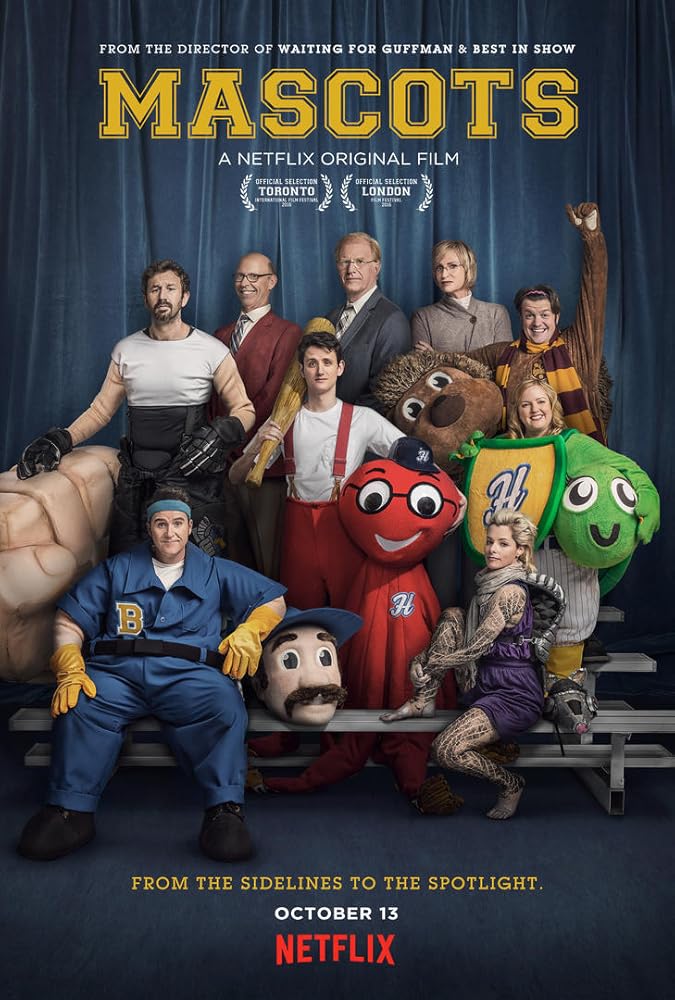
Mascots (2016)
Christopher Guest's Mascots premiered at TIFF earlier this year, but is now available to stream exclusively on Netflix. This time around, Guest takes takes aim at the subculture of mascot performers, with the action focused around the annual 'Golden Fluffy' competition for excellence in the mascot field. For those unfamiliar with the Christopher Guest style, the film takes the form of satirical documentary (or 'mockumentary', as it's commonly known), following the various characters through their journey in the competition. If the film can be said to have a main character, it would be Owen Golly, Jr. (Tom Bennet), a British soccer mascot who is desperately trying to get out of the shadow of his father, who used to perform the same character. In addition, we are introduced to people like Cindi Babineaux (Parker Posey), a woman who takes what can only be described as a unique approach to being a mascot. Various others round out the cast, but the story, such as it is, focuses mainly on these two.
As mentioned above, this film is more a series of amusing, semi-improvised events than a true story of any kind. In a purely comedy driven sense, this works well, but those expecting more in the way of story may be disappointed. That being said, the cast works well with what they're given. Past Christopher Guest veterans Euguene Levy and Hank Azaria are sadly not included in this outing, although many others (Bob Balaban, Jane Lynch, Chris O'Dowd) are present, mixing with newcomers such as Zach Woods (formerly Gabe on The Office) and Sarah Baker. For me, these two provided many of the laughs as a dysfunctional couple who both work as mascots, resulting in a disastrous performance at the competition. Strangely, some of the most amusing things about this film are purely incidental, throw-away moments. Things like fully dressed mascots working out the logistics of using the bathroom, or outlandish looking characters playing cards to pass the time.
Not every joke or character in Mascots is perfect, but it's a very enjoyable, funny movie. I don't feel it quite reaches the heights of Best In Show or This Is Spinal Tap, but it's certainly worth a watch, especially for Christopher Guest fans.
Wednesday, September 14, 2016
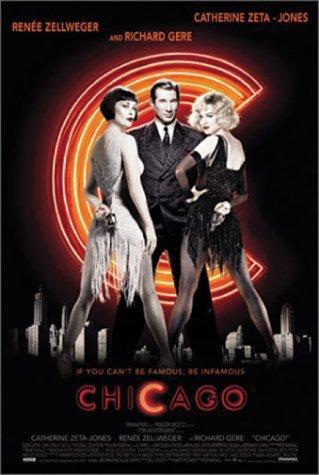
Chicago (2002)
"In this town, murder's a form of entertainment," says Matron 'Mama' Morton (Queen Latifah) early on in Chicago. This is a very precise description of the story told in this film.
Set in 1920s Chicago, we are told the story of Roxie Hart (Renee Zelwegger), an aspiring vaudeville actress who accidentally kills a man who promised her fame and fortune. She's sent to prison where she meets Velma Kelly (Catherine Zeta-Jones). Her story is similar, except she's a legitimate vaudeville star, and did the deed on purpose. Realizing the she's on death row and time is short, Roxie enlists the help of lawyer Billy Flynn (Richard Gere), who will represent anyone for the right price. As it turns out, Flynn is also defending Velma in court at the same time. What follows is a dramatic, and often dishonest, battle for fame in the Chicago courtrooms told in the tradition of vaudeville song and dance.
Along with other films like Moulin Rouge, Chicago is responsible for reigniting an interest in musical films. It also did remarkably well at the 2003 Academy Awards, winning best picture over more serious films like Gangs of New York.
Chicago has an interesting premise, in that the internal dialogue of the characters is told in song and dance. Vaudeville is central to the plot, and the film uses all the facets of the prohibition-era entertainment to great effect. Over the course of the film, we see everything from tap-dancing to comedy to ventriloquism. There's seldom a moment without an accompanying song.
As well as the music, the film borrows some techniques from vaudeville as well. In place of more high-tech methods, the film makes use of traditional theatrical effects like mirrors, well-placed lighting, and even the use of scarves to simulate blood in one number. It all works very well together to give the audience the feeling that they're front-row center at a Broadway production.
The cast are all accomplished in acting as well as song and dance. Some of the choreography Zelwegger and Zeta-Jones perform on top of the acting itself is very impressive. This film is also enhanced by a top-notch supporting cast. I particularly liked John C. Reilly as Roxie's husband Amos, a pathetically sad man who has no understanding of what's really happening with Roxie.
As well put together as the film is, I personally found a felt a little let down in the plot department. There are several potentially interesting plot threads that were left completely unexplored in favour of more musical numbers. In addition, I felt the ending of the film was essentially the lead-in to an elaborate closing song and dance number. I was left wanting some more definitive answers about what happened next, but was left to imagine an ending while the credits rolled.
Despite its few shortcomings, I do think Chicago is a good film. What it lacks in substance, it makes up for in spectacle. While the musical style may not be for everyone, it has something for just about everyone else. It's fun and exciting, and captures all the elements of the prohibition era.
Subscribe to:
Posts (Atom)