Showing posts with label romance. Show all posts
Friday, February 24, 2017
La La Land (2016)
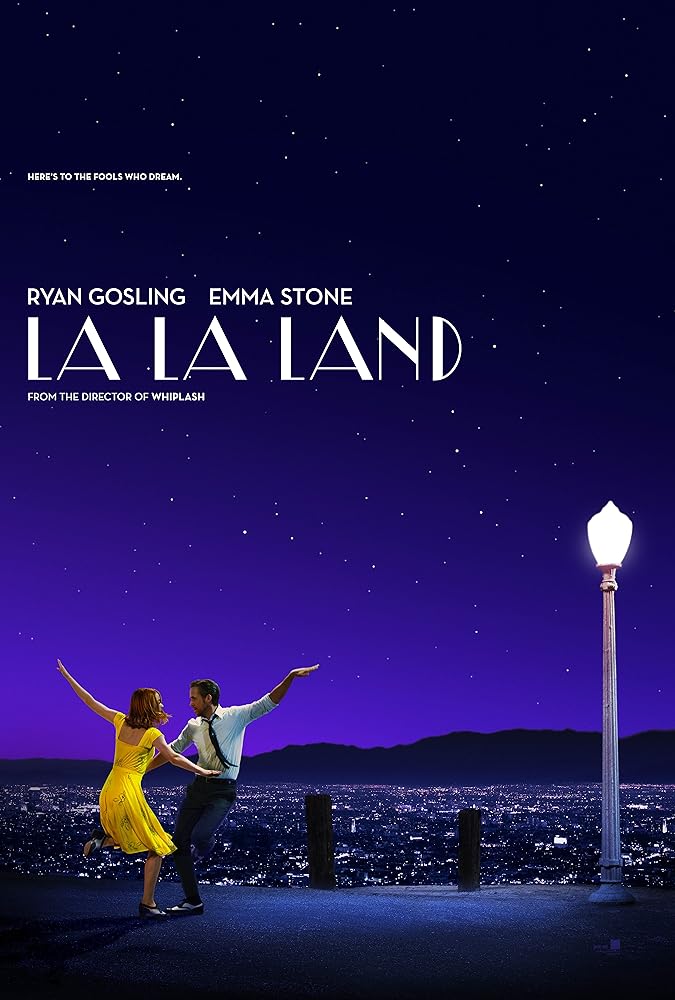
La La Land is one of the most talked about films to come out this year, with multiple Oscar nominations (as of this writing), as well as multiple Golden Globe wins. The film begins its story with Mia (Emma Stone), an aspiring actress who is currently making ends meet by working at a Hollywood coffee shop. Sebastian (Ryan Gosling) is in a similar life situation, forced to play uninspiring music for an unappreciative audience, instead of opening the jazz club he dreams of owning one day. After a few chance meetings, the two fall in love, and begin to seek their dreams together. However, both run into obstacles, and realize that the way to their dreams wasn't at all what they imagined.
La La Land is a wonderfully made film. The cinematography, lighting and choreography are all excellent and deserving of all the awards attention this film has received. The songs are memorable, and will stick in your head in the best way. The acting is equally praiseworthy. Not only do Ryan Gosling and Emma Stone have great onscreen chemistry and captivating performances, but they also sing, dance, and even play piano, in Gosling's case. Of course, if you've read even the smallest media coverage of this movie, you already know all of this. The real magic of La La Land is how it makes you feel when the credits are over.
I saw La La Land in a small town theater (thanks to the folks at the Norgan Theatre!). To the best of my memory, I haven't seen a movie in this type of theatre since the late 90s. Being able to briefly soak in those feelings of nostalgia certainly enhanced the experience for me, so I encourage you to see it somewhere small and local, if you can. As I mentioned before, La La Land is much more than a simple song and dance movie. The ending will feel different for everyone who sees it, but I'm confident it will make you think about your own life and the choices you've made in that time. La La Land also explores the idea of personal dreams and relationships. Sometimes dreams are not what they seem, or the process of achieving them is much different than we imagine. In the same way, people can become different over time, in their ideals and personalities. It's a surprising amount of emotional data to unpack, but it's well worth the price of admission.
In short, La La Land brings back the classical flair of old Hollywood, while at the same time challenging the emotional intellect of the audience. It doesn't claim to have any answers to the questions it raises, but it dares to ask those questions all the same. I think La La Land is a film with class and complexity that will stand the test of time for future generations.
Tuesday, September 27, 2016
Mr. Nobody (2009)
Mr. Nobody is the surrealistic tale of a man known as Nemo Nobody. Some time in the distant future, the one hundred and eighteen year old Nemo is now the last living mortal on Earth. (humans having discovered medical immortality) A reporter secretly finds his way into his hospital room in order to interview him and find out the details of his life. Nemo tells the story of his three distinct lives, insisting that they all happened. We witness the different ways his life unfolds with Elise, Anna, and Jean, each of whom were married to him. As the stories play out in jumbled bits and pieces, things slowly become stranger and stranger. Finally, we are led to a final explanation that makes everything, impossible as it is, make sense.
Mr. Nobody is, at its heart, an experimental art film. This is evidenced by the number of awards it won on the European film festival circuit, and the lack of attention it received in North America. The visuals of the film echo other similar works such as Terry Gilliam's Brazil, or the dreamlike works of David Lynch. This dreamlike quality even carries into the camera work itself. Some scenes are prone to shift in and out of focus, or to run in reverse, reinforcing the confused nature of the narrative.
The narrative itself is good, but also frustrating for those who expect a traditional story. At about the midway point, I found my attention wandering. This was simply because of the slow paced and confusing nature of the story. There is no way to tell what is truth or fiction, and because of this, I found it incredibly difficult to become emotionally invested in any character. This is not to say that the cast doesn't deliver a solid performance, however. Jared Leto does quite well with such a challenging role. This is helped by a top rate makeup department, who provided some of the most captivating, realistic looking age makeup I've seen in some time. My only true criticism is that Nemo appears to magically lose his British accent when he becomes an adult, though the plot does have a built in excuse for any inconsistencies. Of the three wives in the film, Sarah Polley delivers a frighteningly believable performance as a woman suffering from an extreme form of bipolar disorder. Acting-wise, I think Polley's scenes are some of the best in the entire film.
As the film descends into more dreamlike surrealism, the intent of the film as an art piece becomes much more clear. These sequences are the most visually interesting, and a welcome change of pace from the rest of the film. I found the final revelation of the film quite satisfying, but I can completely understand how it might leave many viewers frustrated. As I said at the beginning of this review, Mr. Nobody is an experimental film about memory and choices. On that conceptual level, it works remarkably well. Unfortunately, in the terms of a traditional narrative, it's incredibly difficult to like or care about the characters. So, if you choose to see Mr. Nobody, it's important to go in with the right expectations, or else you're going to be sorely disappointed. If you're a fan of the unusual in film, or like to challenge yourself with your media, this will be right up your alley. If you prefer your stories to have a proper beginning, middle, and end, this probably isn't for you.
Labels:
art-house,
drama,
Jared Leto,
romance,
Sarah Polley,
sci-fi
Tuesday, September 20, 2016
The Phantom of the Opera (1925)
First, a few words about silent films:
Considering the advances in film technology over the past century or so, it can be difficult to appreciate the simpler form of silent film. I find it helps to remember the context of the time period. Back in the 1920s, the art of film was in its infancy. Directors had no true idea what would work for any given audience, and so films were made to appeal to the broadest audience possible. In addition, film was able to transport audiences and give them experiences that were simply not possible with other mediums like books. This means that by today's standards, silent films often have shots that seem to linger far too long, or performers who appear to be constantly overacting with their facial expressions. However, if you can look past these things, and allow yourself to be absorbed with the story, you may begin to discover some of the foundations of great filmmaking. As 2011's The Artist taught us, there was a reason motion pictures became popular, even without the use of sound.
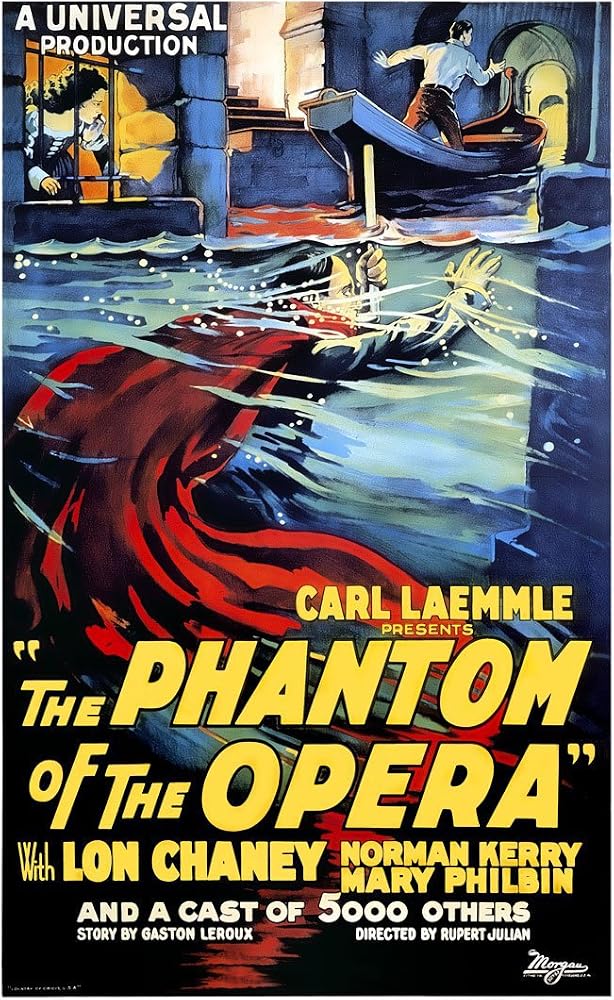
The Phantom of the Opera, based on the classic novel by Gaston Leroux, concerns a mysterious patron of the Paris Opera House. He begins to make strange demands of the casting of the operas, and things take a sinister turn when his demands are not met, and people end up dead. Many believe the opera house is cursed or haunted, but these mysterious happenings are the work of a man known only as 'the Phantom' (Lon Chaney). He takes a special interest in the singer Christine Daae (Mary Philbin), and lures her into his lair underneath the opera house. There, she discovers that the Phantom wants to have her star in an opera he has composed. However, she also makes the discovery that he is hideously deformed. The Phantom allows her to leave one last time, but only on the condition she leaves her lover, the Vicomte Raoul De Chagny (Norman Kerry). Christine refuses his demands, and as a result is kidnapped and held hostage by the Phantom. What follows is a daring rescue mission organized by Raoul along with the French police and opera staff to stop the Phantom's plans before he destroys the opera house.
This film makes great use of large sets, giving the story an appropriately grand feeling. The costuming is also excellent, particularly in the masked ball scene. You get a true feel of the decadence of the era shown onscreen.
Unlike the more sentimental Andrew Lloyd Webber version, this film pulls no punches concerning the grotesque nature of the Phantom. In fact, Mary Philbin's Christine appears to be thoroughly horrified by the Phantom even before his unmasking. The makeup is, of course, one of the biggest talking points of this film. While he went uncredited for it, it is now accepted knowledge that Lon Chaney created his own makeup for this film. The skull-like face is still considered one of the most accurate depictions of the Phantom as described in the book.
One of the most important legacies of The Phantom of the Opera lies with its star, Lon Chaney. He would go on to earn the nickname 'the man of a thousand faces' for his groundbreaking work and performances with makeup. In later years his son, Lon Chaney Jr., would bring to life such classic horror characters as the wolfman. In addition, this film was the beginning of what would become known as the 'Universal Monsters' franchise, one of the most enduring and historically important collections of horror films today. It's unsure if Universal will return to the Paris opera house anytime soon, but with the relaunch of the franchise in the near future, it's quite possible we'll see a new generation's Lon Chaney on screen soon enough.
Subscribe to:
Posts (Atom)